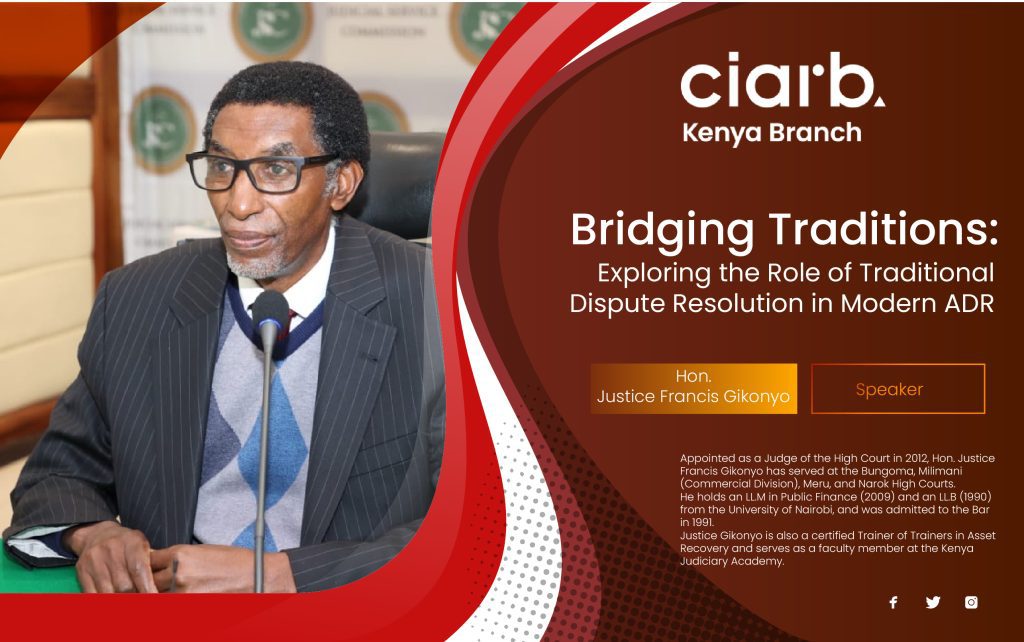
Bridging Traditions: Exploring the Role of Traditional Dispute Resolution in Modern ADR – A Member Dialogue
State of ADR Webinar Session 2
Moderators: Vice chair of CIArb Kenya, David Njoroge
Panelists: Jemimah Alludah, Dr. Steve Akoth and Justice Francis Gikonyo
INTRODUCTION
This session under the State of ADR Webinar Series focused on the current implementation of the Alternative Justice System (AJS) in Kenya. Structured as a guided panel discussion, the moderator, VC David Njoroge, posed targeted questions to unpack the legal, constitutional, and operational frameworks underpinning AJS. The dialogue also examined the intersections between Alternative Justice Systems, traditional dispute resolution mechanisms (TDRMs), and formal judicial systems in Kenya.
GUIDED PANEL DISCUSSION
Q1: What is the history and legal foundation of the AJS Committee?
Dr. Steve Akoth traced the roots of AJS to the constitutional vision of creating a plural legal system that diverges from the colonial legacy where traditional dispute resolution was marginalized. He credited the leadership of former Chief Justice Willy Mutunga for framing AJS as a vital vehicle for access to justice, especially for marginalized communities. He noted that the policy framework was developed to formalize AJS by a taskforce and that the National Steering Committee on the implementation of Alternative Justice policy (NaSCI-AJS) was gazetted by the Hon. Chief Justice David Maraga to implement the policy as a judicial priority.
Jemimah Alludah followed by grounding AJS in Article 1 of the Constitution which affirms the people’s sovereignty to delegate the power to resolve disputes to both courts and alternative mechanisms. She cited Articles 48 of the Constitution of Kenya which emphasizes the importance of ensuring that legal processes and systems are accessible to all citizens, regardless of their socioeconomic status. Also, she highlighted article 159 of the Constitution of Kenya, 2010 which mandates the judiciary to promote Alternative Justice Systems access to justice beyond technicalities, and mentioned. Additionally, section 137 of the Criminal Procedure Code on plea bargaining as well as the ODPP’s plea bargaining policy provide mechanisms for resolving criminal cases through negotiation between the prosecution and the accused, which affirms the legitimacy of AJS.
Q2: How does AJS align with the Chief Justice’s Multi-Door Access to Justice (STAJ) approach?
Justice Francis Gikonyo emphasized that Alternative Justice Systems is the constitutional embodiment of Social Transformation through Access to Justice (STAJ). Additionally, it promotes accessible, people-centered justice in line with Sustainable Development Goal 16: Peace, Justice, and Strong Institutions. He explained that the multi-door approach is uniquely Kenyan in that it emerges organically from the people rather than being imposed legally, and that the judiciary’s role is to ensure that AJS resolutions are just and constitutionally sound.
AJS is the major forum for people seeking justice in line with article 159 & 48 enhancing people’s autonomy to choose where to take their disputes for resolution and the work of the Judiciary is to ensure that the outcomes of the dispute resolution
Q3: What distinguishes ADR, TDRMs, and AJS?
Dr. Steve Akoth described ADR as a set of techniques to resolve disputes (e.g., mediation, arbitration), while TDRMs are traditional customs of the people. He defined AJS as coined by Retired Chief Justice Willy Mutunga to describe other normative systems exercised from birth that people use to access justice and resolve dispute which include, cultural values and mystic power. He emphasized that AJS is not merely ethnic or cultural however it reflects a practice of how people resolve disputes daily within their communities. He also explained that AJS retains judicial authority with the people, reinforcing the judiciary’s role as a facilitator, not a monopolist, of justice.
Q4: What is the strategy for implementing the AJS policy launched in 2020?
Jemimah Alludah shared that implementation of AJS policy involves localizing AJS through county strategy action plans developed via user committees which is composed of stakeholders identified in the various AJS sensitization forums. These plans reflect regional diversity in customs (e.g., Garissa elders) and involve stakeholder sensitization. The action plan also allows us to open up AJS centers and is centered on data that has been collected from the county. To date, 10 counties have launched plans, with 8 more underway. The Judiciary has trained all Supreme Court and Court of Appeal judges, high court judges, 105 magistrates and Registrars, 40 prosecutors, and 20 civil society groups including refugees in AJS principles.
There is also the annual AJS conference where people discuss on how their justice systems are working. In the 4th conference we will map on what has been currently working. Also, it has conducted 3 webinars with Law Society of Kenya to train Advocates of the High courts in Alternative Justice Systems. She highlighted that AJS Secretariat are guided by data collected at the county level and monitored through monthly, quarterly, and annual reports. Jemimah also presented case resolution data from several counties:
· Othaya: 107 cases
· Isiolo: 140 cases
· Kitui: 48 cases
· Mandera: 182 cases
· Kajiado: 366 cases
Q5: How does the doctrine of interaction shape the judiciary’s role in AJS enforcement? Justice Francis explained that the doctrine of interaction addresses how the judiciary relates to Alternative Justice Systems (AJS) and highlighted that historically, judges ignored AJS outcomes, a form of passive disengagement. However, following constitutional reforms, judicial officers have since undergone sensitization to shift their approach. Article 159 of the Constitution mandates the judiciary to promote AJS, prompting a shift toward integration rather than avoidance.
He noted that one problematic form of engagement has been courts treating AJS outcomes as evidence rather than final determinations, especially in matters where parties had fully submitted to the AJS process. He emphasized that this approach undermines the autonomy of AJS and contradicts the principle that there should be no hierarchy between AJS and the formal judiciary when parties have chosen alternative mechanisms. He further stated that judicial interaction should not assume appellate oversight over AJS decisions unless those resolutions conflict with constitutional or statutory provisions.Courts are constitutionally obligated to recognize AJS resolutions unless they violate the Constitution or statutory law. Approval is not required however compliance with legal and constitutional standards is the only basis for review.
Q6: What is the legal recognition framework for AJS decisions within the court system?
Justice Francis Gikonyo noted that courts are only permitted to review AJS resolutions to ensure compliance with constitutional and procedural standards. He explained that court approval is not required if the resolution adheres to these frameworks. He shared examples where courts have formally recognized AJS resolutions, including a Court of Appeal decision (No. 0006 of 2025) involving a dispute among AIC Kisumu church members. The matter was resolved by a council of elders, and the resolution was adopted by the Court of Appeal, marking the appeal as settled.
He also referenced keter & another v. Keter & another (Environment and Land Appeal E003 of 2024) [2024] KEELC 3437 (KLR), a family dispute resolved through the chief’s office, where the court accepted the decision. In another matter, Succession Cause No. 03 of 2022 (Narok), the court upheld an AJS resolution even after a party attempted to challenge it, reaffirming the finality of AJS decisions when parties have consented.
Q7: What is the current role and jurisdictional scope of AJS under the Constitution?
Justice Francis Gikonyo elaborated that the Constitution does not restrict the kinds of cases that can be submitted to AJS. Instead, it anchors the jurisdiction in Article 159 2(c) and the principle of party autonomy. He outlined the Agency Theory developed by the AJS Committee, which provides a two-tier jurisdictional test.
1. The Positive Test- where a party should have the legal capacity to voluntarily consent to submit to AJS.
2. The Negative Test- which examines whether any constitutional, statutory, or policy provision explicitly limits AJS application in a given matter. For example, he noted that the Sexual Offences Act prohibits resolving defilement cases through AJS due to the seriousness of the offense.
He concluded that while AJS is expansive, its limits are defined by legal frameworks and the nature of the subject matter.
Q8: What is the judiciary’s mandate in promoting AJS?
Dr. Steve Akoth clarified that under Article 159(2)(c), the judiciary is required not only to acknowledge AJS but also to actively promote its development and transformation. He outlined a three-part obligation imposed on the judiciary:
1. to respect AJS mechanisms,
2. to protect them from interference and misuse
3. To transform them to align with constitutional values.
He emphasized that the duty to transform includes changing court attitudes, practices, and approaches toward community-based dispute resolution. He referenced the Dispute Resolution Bill, which is currently undergoing public participation, as a legislative effort to entrench AJS within the justice system and operationalize the judiciary’s broader mandate under the Constitution.
Q9: How does the judiciary ensure gender inclusivity and diversity in AJS panels?
Jemimah explained that panel formation is guided by constitutional principles under Article 27, which calls for inclusivity and equal representation. She stated that in court-annexed mediation, registrars conduct screening to ensure expertise and diversity in the appointed panels. She added that state officers such as chiefs and children officers are often called upon to facilitate resolutions in their official capacity.
She also highlighted the role of civil society organizations in providing trained personnel to guide AJS processes. Jemimah noted that there is a growing emphasis on involving women and youth in AJS, particularly in northern Kenya where, for instance, a woman currently chairs the AJS Council in Samburu. This represents a cultural shift and affirms that the judiciary is playing a role in reshaping traditional norms around inclusion.
Q6: How does the judiciary distinguish legitimate AJS from extrajudicial practices like mob justice?
Dr. Steve Akoth clarified that while AJS draws from traditional and community-based justice systems, not all community responses to disputes qualify as AJS. He cited instances of mob
justice such as lynching of motorcycle thieves by boda boda riders as examples of criminal behavior rather than alternative dispute resolution.
He emphasized that for any mechanism to be recognized as AJS, it must comply with the Constitution and not contravene the Bill of Rights. He reaffirmed that AJS decisions must not be repugnant to morality and must adhere to national values under Article 10. He stressed that justice mechanisms involving violence or violating human dignity fall outside the scope of legitimate AJS.
Q7: Are AJS outcomes enforceable, and how does enforcement occur? Justice explained that most AJS outcomes are considered self-executing due to their reliance on community legitimacy and voluntary compliance. However, he added that where necessary, parties may formalize AJS agreements by filing them in court and obtaining consent orders. He noted that enforcement through court orders is typically only required when one party fails to honor the agreed resolution. Otherwise, AJS outcomes are generally respected within the community and do not require judicial intervention.
Q8: Can certain political or statutory matters be handled through AJS? Justice noted that while the Constitution supports AJS, jurisdictional limitations still apply in certain legal contexts. He explained that statutes governing political and inter-governmental disputes establish formal processes that must be followed.
Jemimah added that while Article 159(2)(c) grants judicial discretion to use other dispute resolution methods, the principle of party autonomy allows unresolved matters to return to the courts if AJS mechanisms fail.
Q9: What role does academia play in advancing AJS principles? Dr. Steve Akoth emphasized that academia has a vital role in embedding AJS within Kenya’s legal education and discourse. He stated that the judicial system, though structured, is built upon a foundation of plural legal traditions reflected in the Constitution of Kenya 2010. He called on universities to integrate AJS into their curricula and equip students with the tools to understand, apply, and improve community-based justice systems. He also recommended that institutions of higher learning host academic conferences and research initiatives focused on evaluating AJS as a legitimate and evolving model of justice delivery.
FINAL REMARKS
What are the challenges and opportunities in implementing AJS?
Jemimah highlighted several key implementation challenges currently facing AJS at the county and national levels. She pointed out that in counties where the AJS Action Plan has not yet been formally launched, operationalizing AJS remains stalled. She added that personnel and resources are still inadequate to fully implement the STAJ (Social Transformation through Access to Justice) strategy. Another challenge involves the lack of inclusivity, particularly where
some communities or actors fail to uphold Article 47 on fair administrative action, thereby excluding minorities or marginal voices from the AJS process.
Dr. Steve Akoth noted a cultural and perceptual barrier: many people continue to view AJS with skepticism, dismissing it as informal or illegitimate; labeling it a “kangaroo court”, without understanding how it operates within community structures. He emphasized the need for further public education and sensitization to reframe the court’s role and demonstrate AJS as a complementary, not inferior, pathway to justice. He concluded by flagging concerns about integrity among some panelists, underlining the need for ethical guidelines and monitoring.
The Vice Chair (VC) observed that despite these challenges, AJS has resolved approximately 79% of the matters submitted to it; which is an indication of its effectiveness and growing credibility across counties.
Justice Francis Gikonyo, reflecting in his capacity as a member of the AJS Steering Committee, reaffirmed the potential of AJS to deliver faster and more efficient justice to Kenyans. He posed a reflective question on whether AJS should continue evolving organically within communities or be more formally regulated. He stated that the judiciary has a constitutional responsibility to make AJS work not only to benefit Kenyans but also to establish Kenya as a model for promoting community-based justice in Africa. He concluded by calling for deeper international engagements, stressing the importance of positioning AJS as a viable and exportable justice model for other African nations.
CIArb Kenya Branch Chairman FCS Jaqueline Waihenya expresses her deepest gratitude to all the valued partners, fellows, and members who attended the significant event of celebrating 40 Years of Excellence
Are you interested in understanding how disputes are resolved outside traditional court proceedings? Would you like to explore a professional career in arbitration, mediation or other forms of Alternative Dispute
Africa Decides: Sovereignty, Innovation & the Future of Dispute Resolution 5–9 October 2026 | Diamond Leisure Lodge, Diani, Kenya Conference Overview The TAKUKA Conference 2026 is a landmark Pan-African gathering
Sometimes, professional partnerships feel less like partnerships and more like family. That was certainly the spirit of today’s engagement between FIDA Kenya and Ciarb Kenya, where two organisations united by