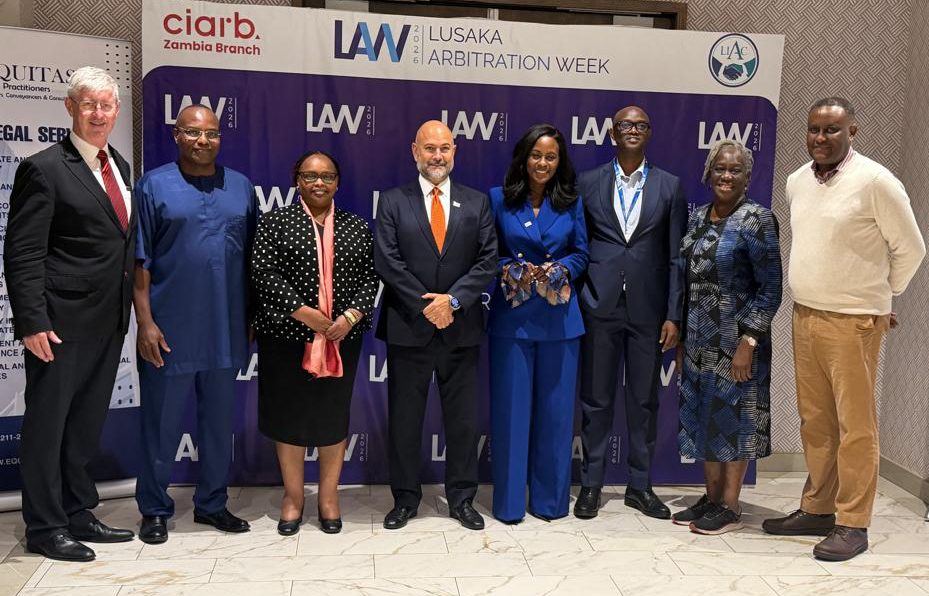
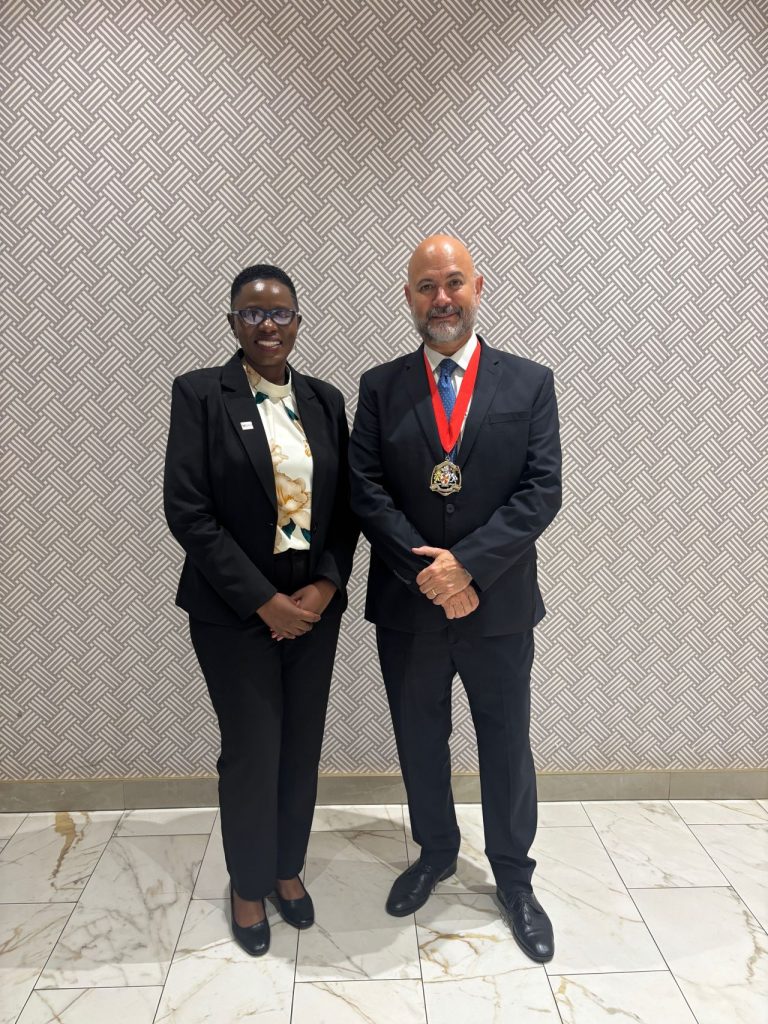
Lusaka International Arbitration Centre Court of Arbitration – Ciarb Global President Cesar Pereira, C.Arb
At independence, Zambia was among the most prosperous countries in sub-Saharan Africa by mineral export earnings. Its copper mines were producing 700,000 tonnes a year. The world came to invest, and Zambia’s future looked limitless.
What followed is a story this country knows better than anyone: a global commodity crash, then decades of underinvestment. Enormous potential left in the ground.
But that is not the story Zambia is writing now.
Today, Zambia has set a target that no one in the global mining industry can ignore: three million tonnes of copper per year by 2031 — a quadrupling of output in six years. The world is responding. Twelve billion dollars in new investment have flowed in. Barrick Gold is investing two billion dollars at the Lumwana Super Pit. First Quantum Minerals is investing one and a quarter billion dollars at Kansanshi. KoBold Metals has confirmed the largest copper discovery in the country in over a century, with ore grades six times the global average.
The timing is extraordinary. The International Energy Agency projects a 30% supply shortfall by 2035. S&P Global forecasts a ten-million-tonne deficit by 2040. Copper is becoming scarcer. Yet every electric vehicle, every wind turbine, and every AI data centre runs on copper. The world doesn’t just want what Zambia has. It needs what Zambia has.
And every dollar of that twelve-billion-dollar investment carries a question — one every investor asks: if something goes wrong, if a concession is disputed, a tax regime shifts, or a contract is challenged, what do I do?
That question is why we are here.
Our central thesis is simple: proper, sound, reliable dispute resolution is just as important as any other piece of infrastructure.
You cannot build a mine and then hope for electricity, or build a port and then hope for a road. Likewise, we cannot invite billions of dollars in foreign capital and then hope that, somewhere, somehow, a mechanism will exist to resolve the disputes that will inevitably arise.
Dispute resolution is a precondition for investment, not an afterthought.
The Bingham Centre for the Rule of Law surveyed 301 chief executives of the world’s largest companies — each running businesses with more than a billion dollars in annual revenue. When asked what determines where they invest, the strength of the rule of law — enforceable laws, access to fair tribunals, and functioning legal institutions — ranked among the top three factors, alongside political stability and ease of doing business.
Academic research reinforces this. A 2011 WTO Working Paper by Axel Berger found that the foreign direct investment effect of bilateral investment treaties derives primarily from their dispute settlement provisions — from arbitration. Treaties without arbitration clauses produced no measurable increase in investment. The arbitration clause is the load-bearing wall.
Justice Oliver Wendell Holmes Jr. once warned that obligations which exist but cannot be enforced are ghosts. A mining concession worth two billion dollars is only as valuable as the mechanism standing behind it. Without dispute resolution, commitments are ghostly — they appear solid but dissolve on contact.
This is why the ADR Draft Bill being handed over today is, in itself, an infrastructure project. Five years in the making, it is designed to ensure that every commitment Zambia makes to an investor — and every commitment an investor makes to Zambia — is something more than a ghost.
A Global System in Transition
The global investment treaty regime is being redesigned. There are over 2,600 bilateral investment treaties in force worldwide. Most were signed in the 1990s and early 2000s, sharing broad most-favoured-nation clauses, expansive fair-and-equitable-treatment standards, and wide access to investor-state arbitration.
That era is ending.
Data from UNCTAD shows a clear shift. In treaties signed since 2020:
49% replace or remove the fair-and-equitable-treatment standard (compared to 5% before 2010).
62% refine or remove most-favoured-nation clauses (compared to 6% before 2010).
87% include regulatory carve-outs for indirect expropriation (compared to 6% in older treaties).
43% contain no investor-state dispute settlement provisions at all.
This is the maturation of dispute resolution.
Zambia is not trapped in the old model. It has 17 bilateral investment treaties. The most recent, the Japan–Zambia BIT signed on 6 February 2025, reflects modern design: fair and equitable treatment limited to customary international law minimum standards; procedural rights excluded from MFN treatment; denial-of-benefits clauses preventing shell company abuse; and specific protections for natural resource exploration and exploitation.
The treaties Zambia signs today will shape how disputes are framed for decades.
The Rise of Contract-Based Arbitration
There is also a quieter shift underway.
Recent statistics from the International Centre for Settlement of Investment Disputes show that 21% of newly registered investment cases are now based on contracts, up from 6% the year before. Treaty-based claims have declined below historical averages.
The implication is clear: the arbitration clause in a mining concession, power purchase agreement, or infrastructure contract is increasingly more consequential than the treaty above it.
In December 2022, a London-seated tribunal issued a consent award in a dispute between ZESCO and Maamba Collieries, worth approximately 500 million dollars — arising not from a BIT, but from a contract.
Now multiply that across Zambia’s investment pipeline: new power purchase agreements, renewable energy projects, mining concessions aimed at reaching three million tonnes of copper by 2031. Each contains — or should contain — a carefully designed arbitration clause. The seat, rules, institution, and scope will determine how billion-dollar disputes are resolved for decades.
Building the Domestic Architecture
This is where the ADR Bill becomes practical reality.
The Bill proposes a consolidated framework for arbitration and mediation, updating legislation that has not been revised since 2000. The Lusaka International Arbitration Centre (LIAC), commissioned in April 2024, now administers cases and provides model arbitration clauses for direct incorporation into contracts.
Institutional capacity is growing in parallel.
The UNIDROIT International Programme for Law and Development is training African legal professionals in commercial contract governance. The International Council for Commercial Arbitration has worked with Zambian judges on award enforcement since 2012. The Permanent Court of Arbitration has strengthened continental arbitral cooperation. The Chandler Institute of Justice has made Zambia its pilot country for legislative reform strategy.
The message to investors in Toronto, London, or Tokyo is changing. They see:
A dedicated arbitration centre in Lusaka.
A judiciary trained in enforcement under the New York Convention.
A modern bilateral investment treaty network.
A consolidated ADR legislative framework moving toward Parliament.
An international training pipeline aligned with global standards.
As Jan Paulsson observed, the enforcement power of the New York Convention gives citizens “the power to make meaningful promises.”
That is what is being built here: a meaningful promise.
Copper and Predictability
Zambia produced 890,000 tonnes of copper last year — a national record. One million tonnes is targeted this year. Three million by 2031.
But between here and three million tonnes lies something no drill bit can reach: predictability.
Predictability does not come from good intentions. It comes from institutions.
And institutions are being built — deliberately, systematically, and with purpose.
Three Requests
To government officials: the arbitration clause in your next mining concession, power purchase agreement, or infrastructure contract is an investment signal. Use LIAC’s model clauses. Specify Lusaka as the seat. Make enforceability a design feature of every major agreement.
To investors: disputes can be resolved here. LIAC is operational. The judiciary is arbitration-friendly. Zambia is a signatory to the New York Convention, enforceable in 172 jurisdictions. The question is whether you will choose Lusaka-seated arbitration and invest in the ecosystem that protects your business.
To practitioners: globally, 90% of ICSID awards are voluntarily complied with. That should be Zambia’s floor, not its ceiling. Hold these institutions to the highest international standards.
Douglass North received the Nobel Prize for demonstrating what investors intuitively know: institutions determine economic success.
Zambia does not need to debate that proposition. It is building the proof.
CIArb Kenya Branch Chairman FCS Jaqueline Waihenya expresses her deepest gratitude to all the valued partners, fellows, and members who attended the significant event of celebrating 40 Years of Excellence
From 5th -9th October, 337 people from 16 countries gathered at Diamond Leisure Lodge in Diani, Kenya, for TAKUKA 2026. Arbitrators, mediators, adjudicators, sitting judges, government officials and young practitioners
A landmark initiative to advance trade law harmonisation, strengthen Kenya’s global commercial standing, and create new opportunities for legal professionals, businesses and the next generation of African commercial lawyers. Nairobi
The Chartered Institute of Arbitrators (Ciarb), Kenya Branch, invites applications for its Commercial Mediation Training & Accreditation Programme, designed for professionals seeking practical mediation skills and a pathway towards becoming